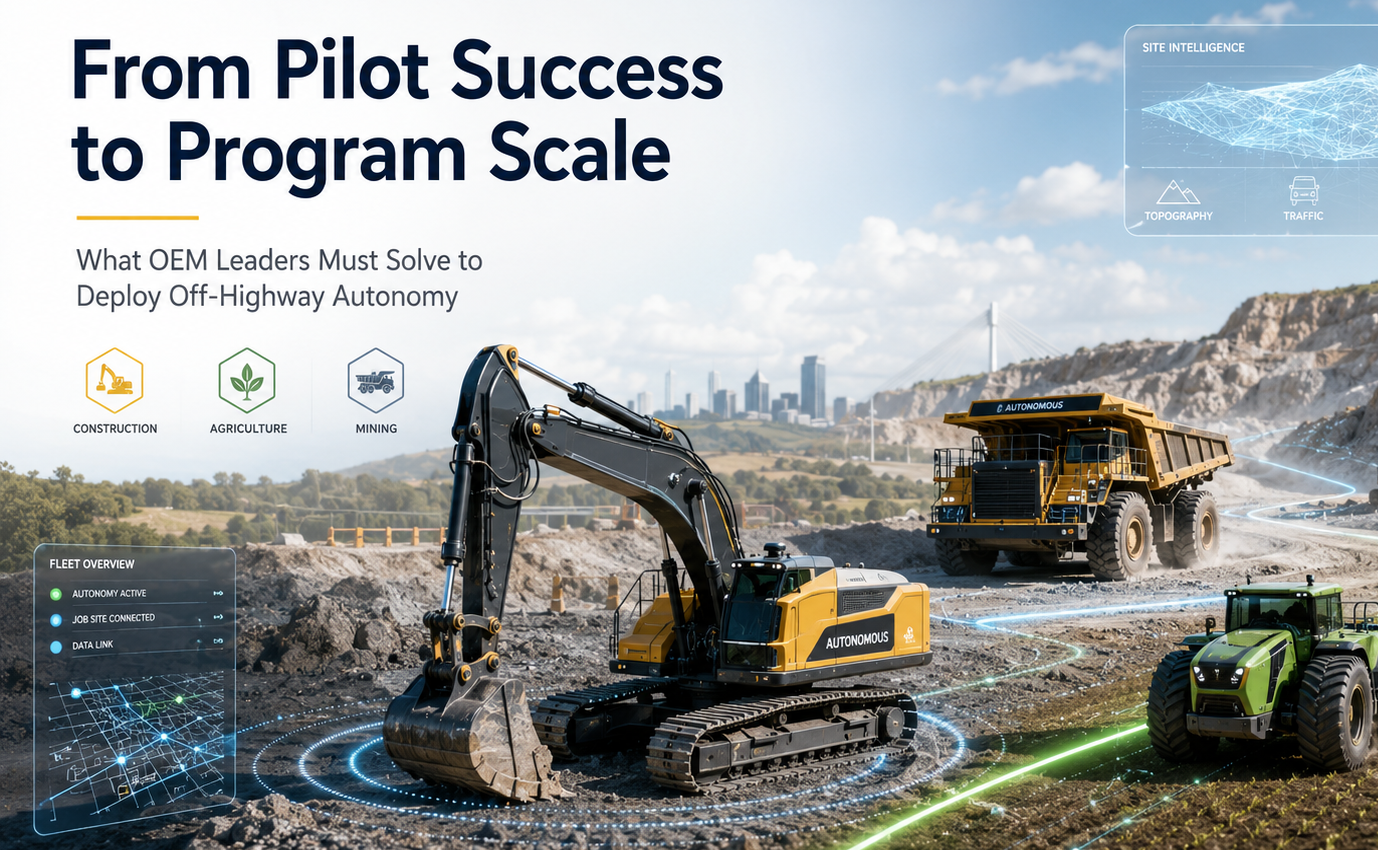
Off-highway autonomy is no longer a concept problem. It is now a deployment problem. For OEMs, the critical questions are safety, validation, interoperability, cybersecurity, positioning, and ROI in the real environments where machines actually work.
By Orbimind | Off-Highway Autonomy & Robotics 2026 | 8-minute read
Autonomous off-highway machines must prove reliability in the environments where they actually operate.
Off-highway autonomy has entered a more demanding phase.
The industry has already shown that autonomous functions can work in controlled trials and tightly scoped use cases. The real challenge is scaling those capabilities into dependable daily operations across construction, mining, agriculture, forestry, and industrial sites.
In these environments, terrain changes, visibility degrades, GNSS can become unreliable, and machines must operate alongside people, contractors, manually driven assets, and mixed fleets.
For OEMs, the next stage is no longer about proving that autonomy is technically possible. It is about proving that it can be deployed safely, validated efficiently, integrated across fleets, protected against cyber risk, and justified commercially.
Safety Is Now a Market-Access Issue
For OEMs, safety is no longer only a compliance requirement or a subsystem concern. It is what determines whether an autonomous function can move from trial mode into real customer operations.
Autonomous machines must cope with dust, mud, slopes, occlusions, poor traction, unstable surfaces, changing site geometry, and unpredictable human behaviour.
In these environments, fixed safety functions are not always enough. Systems must recognise uncertainty, assess changing risk, and decide how to reduce that risk in the current situation.
This creates a more demanding safety challenge for OEMs. The machine must not only operate correctly when conditions are ideal. It must also degrade safely when sensors, communications, positioning, or control functions become unreliable.
Key OEM question:
Can the system identify uncertainty, enter a safe degraded mode, and remain predictable when conditions change?
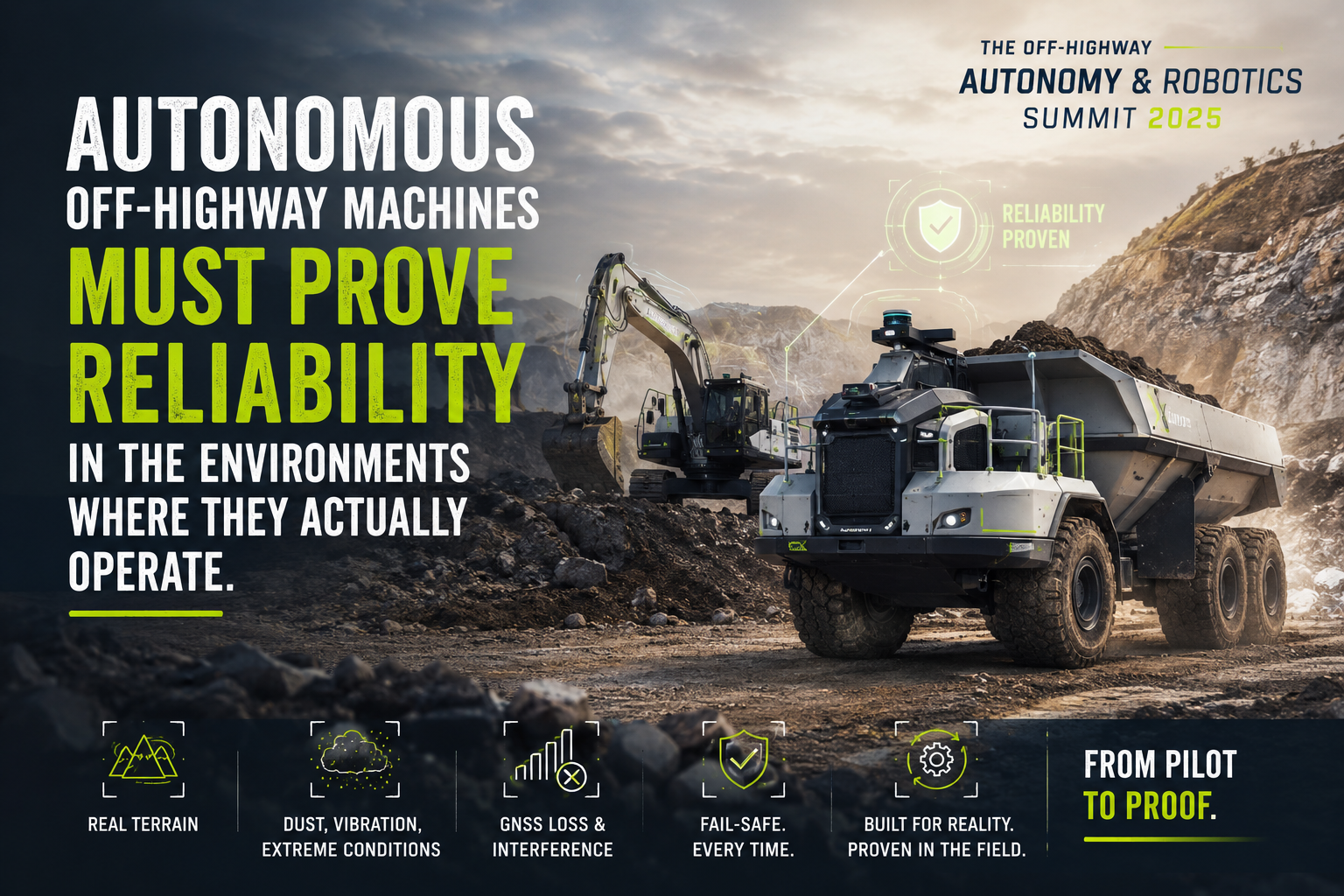
Autonomous machinery must maintain safe behaviour even when visibility, terrain, or system performance degrades.
Validation Is the Hidden Cost Centre of Autonomy
The largest scale-up bottleneck is often not perception quality or control logic in isolation.
It is the validation burden created when those systems must be proven across multiple terrains, weather conditions, visibility states, machine variants, operational behaviours, and edge cases.
Traditional field testing remains essential, but it becomes expensive and difficult to scale when every software update, sensor change, or machine configuration creates new validation requirements.
This is why digital twins, simulation, automated testing, and high-performance computing are becoming central to autonomy development.
Virtual validation allows OEMs to generate large numbers of scenarios, automate KPI logging, compare system behaviour, and reduce dependence on repeated physical field campaigns.
Validation at Scale
- 128 procedurally generated test cases were used in one recent off-road validation study
- Automated KPI logging and report generation reduced manual testing effort
- Simulation environments can test weather, obstacles, terrain, sensor failures, and machine behaviour
- Digital twins can shorten development cycles and reduce the cost of field validation
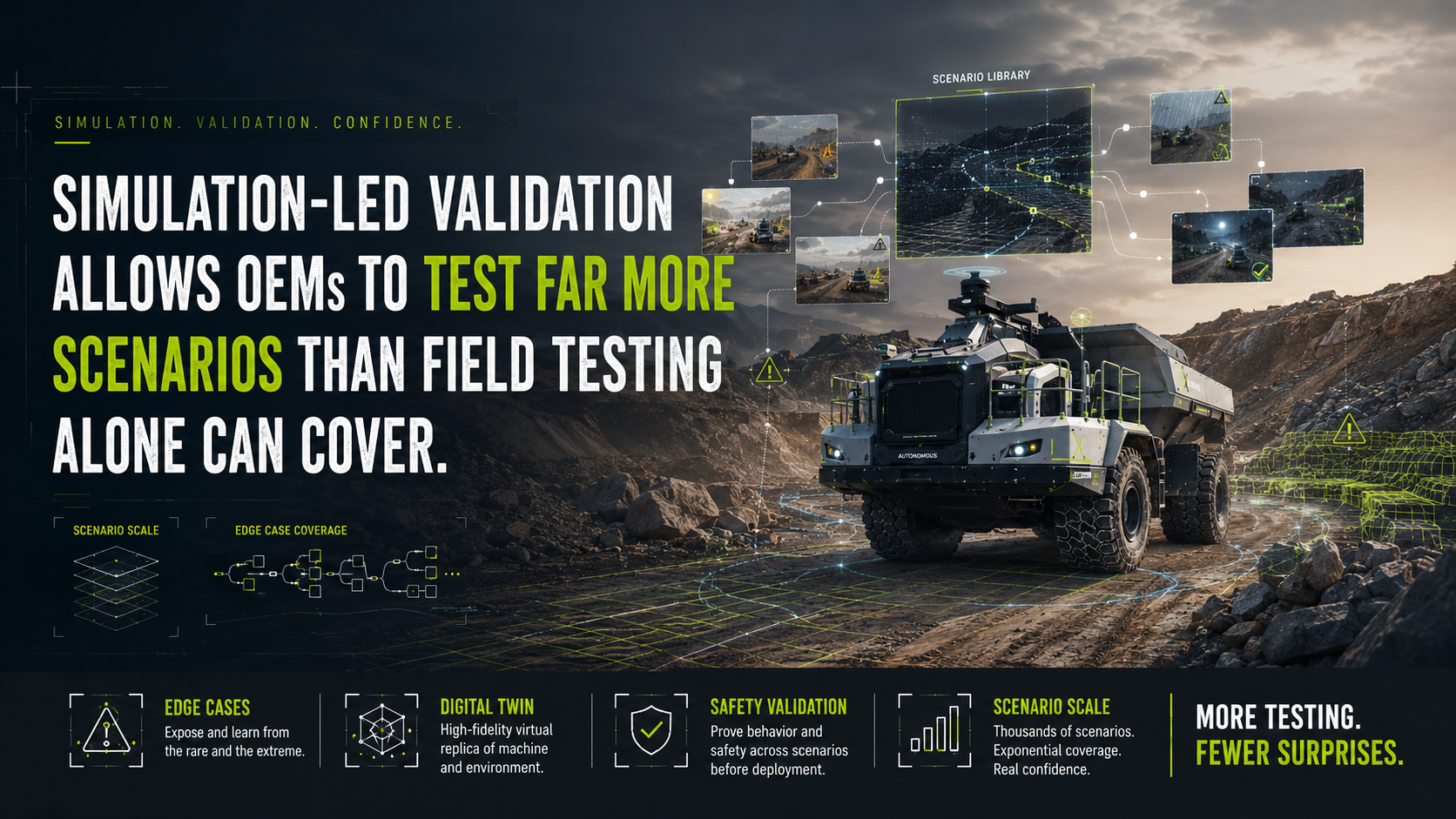
Simulation-led validation allows OEMs to test far more scenarios than field testing alone can cover.
Interoperability and Fleet Orchestration Determine Whether Autonomy Can Scale
OEMs do not deploy autonomous machines into clean, isolated environments.
Real construction sites, mines, farms, and industrial areas contain mixed fleets. These may include machines from several OEMs, manually operated equipment, contractors, site-control platforms, and multiple communication systems.
Customers increasingly care about site-level execution rather than machine-by-machine automation.
That means autonomy must support:
- Cross-OEM communication
- Shared routing and work-zone logic
- Fleet supervision
- Interaction between autonomous and manually driven machines
- Data exchange with site-management platforms
- Clear responsibility between the OEM, operator, and integrator
If an autonomy system only works within one OEM ecosystem, customers may inherit data silos, operational friction, and vendor dependency.
If it works across the entire site, it becomes easier to justify procurement, supervision, workflow redesign, and long-term scaling.
The real deployment unit is not one machine. It is the entire worksite.

Scaling autonomy requires coordination across machines, operators, supervisors, and site infrastructure.
Partner Strategy Is Product Strategy
Autonomous machinery depends on multiple technology layers:
- Sensors and perception
- Simulation and digital twins
- Embedded compute
- Electronic control systems
- Positioning and navigation
- Connectivity
- Functional safety
- Cybersecurity
- Fleet software
- Validation and testing
Very few OEMs can or should build the entire stack internally.
The important strategic question is not whether OEMs need partners. It is which layers they should own, which they should standardise, and which they should source from specialist providers.
Partner choices directly influence:
- Integration speed
- Validation workload
- Cybersecurity exposure
- Software update control
- Supplier dependency
- Long-term platform ownership
- Interoperability across machine families
A poor partner decision can create years of integration and lifecycle problems. A strong ecosystem can reduce time to market and make autonomy easier to scale across multiple products.
Are You Leading Autonomy, Advanced Engineering, Safety, or Product Strategy at an OEM?
Join your peers at Off-Highway Autonomy & Robotics 2026 in Munich on 28–29 October 2026.
Cybersecurity Has Merged with Functional Safety
Once machines are connected, remotely supervised, data-rich, and updateable, cyber risk becomes part of the safety case.
Autonomous off-highway systems may depend on:
- Remote supervision
- Fleet communications
- Cloud-connected services
- OTA software updates
- Positioning corrections
- Machine telemetry
- Operator interfaces
- Supplier software components
A cyber incident can affect more than data confidentiality. It can influence machine movement, operational availability, safety functions, and control authority.
For OEMs, cybersecurity therefore cannot remain an isolated IT responsibility.
It must be integrated into:
- Platform architecture
- Functional safety processes
- Supplier governance
- Software update strategy
- Threat analysis and risk assessment
- Verification and validation
Cybersecurity is no longer an IT issue. It is part of the machine safety case.
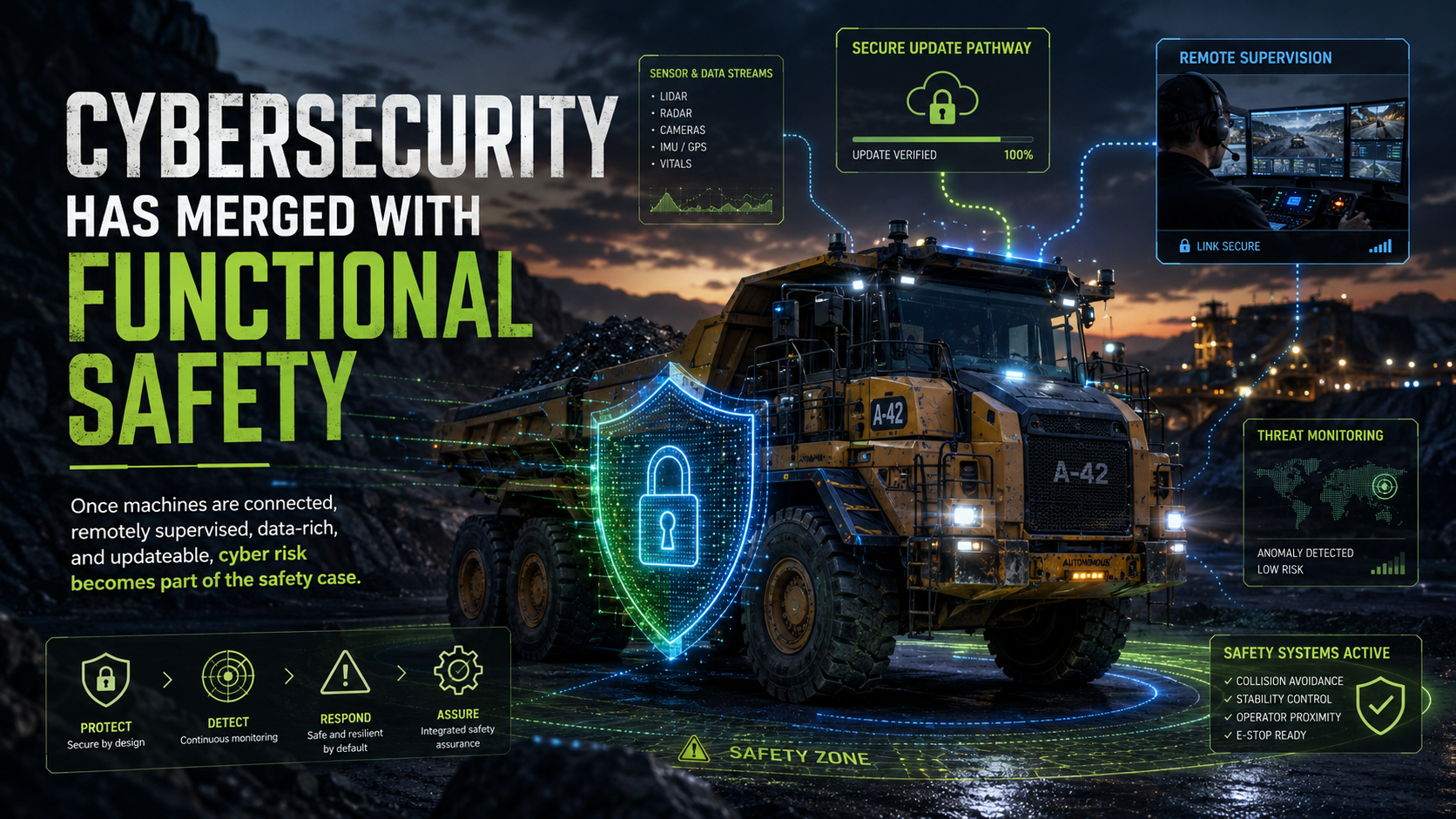
Connected and updateable machines require safety and cybersecurity to be engineered together.
Positioning and Connectivity Are Infrastructure, Not Features
Off-highway autonomy is often presented as an AI problem.
In practice, deployment frequently depends on whether the machine can maintain reliable positioning and communication in difficult environments.
Mining areas, construction sites, forests, vineyards, and industrial yards may contain:
- GNSS obstruction
- Multipath interference
- Tunnels or underground areas
- Dust and poor visibility
- Limited network coverage
- Rapidly changing site layouts
- Tall structures or terrain that blocks signals
This is why resilient autonomy requires more than standalone GNSS.
OEMs increasingly combine:
- RTK corrections
- Inertial navigation
- Sensor fusion
- Dead reckoning
- Visual localisation
- Radar or LiDAR-based localisation
- Rugged machine-to-machine communication
Positioning and connectivity should therefore be treated as site infrastructure, not optional machine features.
Infrastructure Matters
- Evaluation methods can significantly understate absolute positioning error
- Open-sky performance does not represent underground or obstructed conditions
- GNSS degradation can affect safety, repeatability, and operational continuity
- Positioning reliability must be validated across the full operating environment
ROI Must Be Specific, Not Futuristic
OEMs and operators do not scale autonomy because the technology is impressive.
They scale it when it creates a measurable operational outcome.
The strongest business cases are linked to:
- Fewer safety incidents
- Higher machine utilisation
- More productive operating hours
- Reduced labour dependency
- Better precision
- Lower material waste
- Reduced downtime
- Improved work in hazardous environments
- More predictable fleet performance
The challenge is that publicly comparable ROI figures remain limited.
Many companies discuss total cost of ownership, productivity, and safety benefits, but few publish equivalent payback periods, deployment timelines, or per-machine savings.
That makes it difficult for OEM leaders to compare programs using public data alone.
The more useful question is not:
Does autonomy create value?
The useful questions are:
- Where does autonomy create value first?
- Under what operating conditions?
- Which costs appear during deployment?
- How much organisational change is required?
- What level of supervision is still needed?
- How long does it take to move from pilot to stable operation?
OEMs do not scale autonomy because it is impressive. They scale it because the operating case is clear.
Why This Is the Right Moment for OEMs to Convene
The market is moving toward supervised and scalable autonomy.
That shift requires agreement on:
- Safety concepts
- Validation methods
- Positioning and connectivity
- Mixed-fleet interoperability
- Cybersecurity
- Operator responsibility
- Supplier integration
- Commercial deployment models
Public sources describe the technical direction clearly, but they rarely reveal the cost curves, operational compromises, deployment timelines, and internal decisions OEM executives need.
That information still moves through operator feedback, private pilots, peer exchange, and focused industry discussion.
This is why technical and operational forums matter.
The next phase of off-highway autonomy will not be determined only by better algorithms. It will be determined by whether OEMs, operators, technology suppliers, and research organisations can solve the deployment problem together.
Evidence Signals OEM Leaders Should Watch
- 128 test cases: One recent off-road validation study used 128 procedurally generated test cases with automated KPI reporting.
- 100 environments and 1,000 tasks: A recent off-road mobility benchmark included 100 unique environments and 1,000 navigation tasks.
- 30% improvement: A risk-aware off-road navigation study reported a 30% improvement in navigation success rate.
- Up to 76% error understatement: One positioning study found that standard evaluation methods could understate absolute positioning error by as much as 76%.
These figures are not directly comparable commercial metrics, but they show the growing evidence burden behind autonomy deployment.
From Pilot Success to Deployable Programs
Pilots prove that autonomy can work.
Programs prove that it can operate reliably, safely, and commercially across different machines, environments, customers, and operating conditions.
For OEMs, the next challenge is no longer proving the concept.
It is proving:
- The safety case
- The validation model
- The fleet-integration strategy
- The cybersecurity architecture
- The positioning and connectivity infrastructure
- The partner ecosystem
- The operating model
- The ROI
If your team is moving from autonomy pilots to productised, deployable off-highway systems, the next challenge is no longer proving the concept.
It is proving the operating model.
Continue the OEM Conversation in Munich
Off-Highway Autonomy & Robotics 2026 brings together OEMs, operators, technology partners, and research leaders focused on deployment, safety, validation, interoperability, positioning, connectivity, and scalable operations.
📍 Munich, Germany
📅 28–29 October 2026
Who Should Attend?
- OEM engineering leaders
- Autonomy system architects
- Robotics and AI teams
- Functional safety specialists
- Validation and simulation leaders
- Cybersecurity engineers
- Fleet and site-operations leaders
- Digital transformation teams
- Positioning and connectivity specialists
- Off-highway technology suppliers